

 Facebook
 X
 Pinterest
 Copy Link
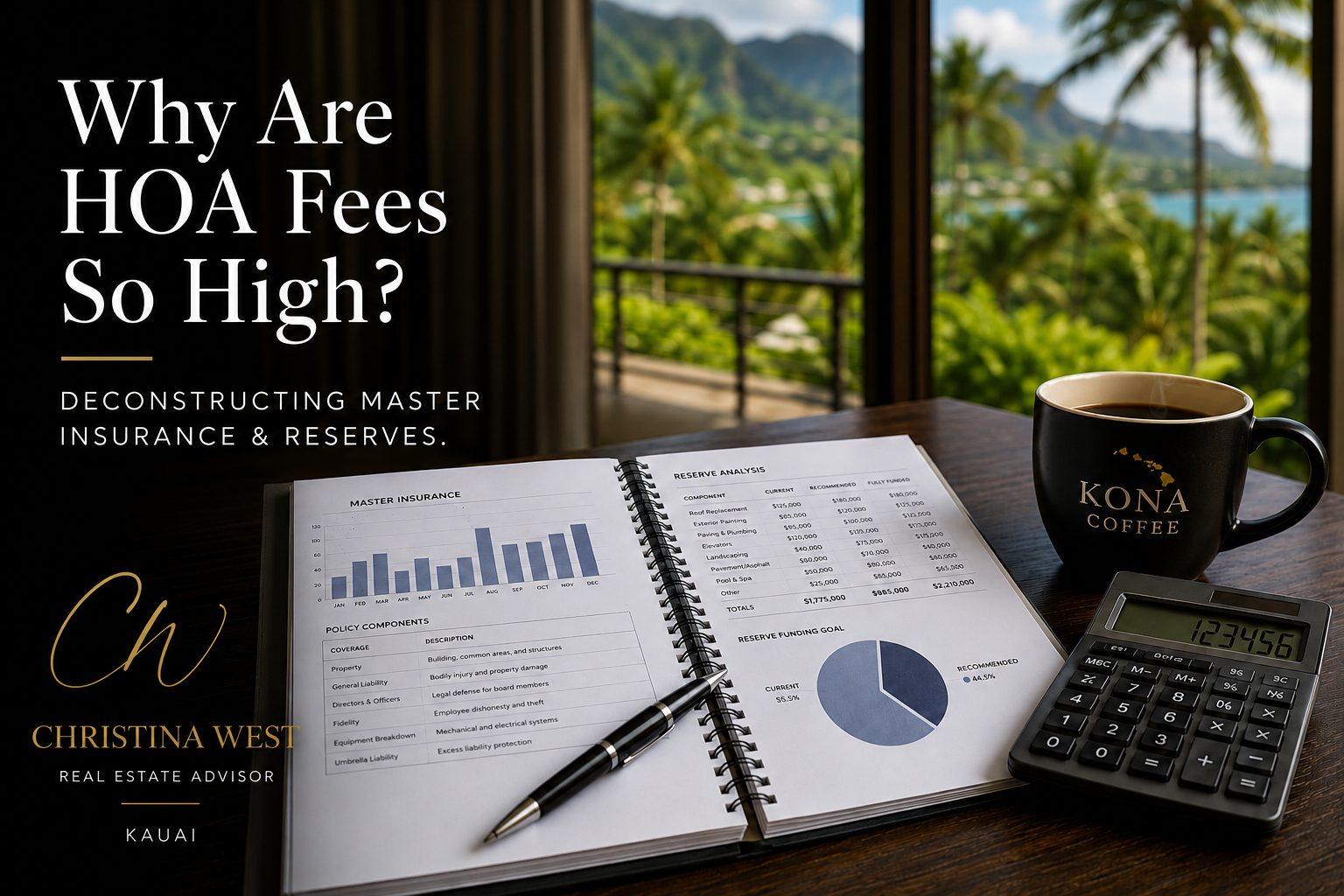
Beyond the Sticker Shock: The Real Financial Drivers Behind Hawaii HOA & AOAO Dues
When evaluating luxury real estate on the Garden Isle—whether looking at bluff-front villas or reviewing Princeville luxury homes for sale—buyers frequently experience a moment of pause when reviewing the monthly HOA (Homeowners Association) or AOAO (Association of Apartment Owners) dues.
In Hawaii, monthly association fees for luxury condominiums and planned communities routinely range from $800 to well over $2,000 per month. To mainland buyers accustomed to paying $250 a month for a neighborhood pool, these figures can look like a misprint.
However, viewing high association dues simply as an added expense misses the broader financial reality. On an isolated island in the middle of the Pacific, HOA and AOAO dues operate as a collective risk-management framework.
Understanding where every dollar goes transforms what looks like “sticker shock” into a predictable, line-item asset protection strategy.
- The Master Insurance Crisis: Reinsurance & Hurricane Coverage
The single largest catalyst driving Hawaii AOAO dues upward over the past several years is the master property insurance market.
Condominium associations in Hawaii are legally required to carry master insurance policies that cover the entire building shell, common areas, and hurricane risk. Because Hawaii is exposed to tropical storms and oceanic weather patterns, local insurers rely heavily on global reinsurance markets (insurance for insurance companies).
Following unprecedented global climate events and national storm claims, global reinsurance rates have surged. On Kauai, many condo boards have seen their master insurance premiums double or triple virtually overnight. Higher monthly dues are often the direct result of a proactive board securing full coverage to protect owners from catastrophic out-of-pocket loss.
- The Salt-Air Factor: Accelerated Environmental Wear
Mainland structures battle seasonal cold and rain; Hawaiian structures battle a continuous, aggressive environmental baseline: salty ocean air, high humidity, and intense UV exposure.
- Concrete Spalling: Salt air penetrates concrete over time, causing internal steel rebar to rust, expand, and crack the concrete (known as spalling). Repairing concrete spalling requires specialized structural engineering and high-cost remediation.
- Exterior Painting & Roofs: Coatings that last 15 years in dry mainland climates often require repainting or recoating every 5 to 7 years on Kauai to maintain water-tight envelopes.
- Landscaping & Water: Maintaining lush, tropical landscaping across multi-acre resort grounds requires continuous irrigation, specialized botanical care, and tree-trimming to prevent storm hazards.
- The Island Logistics Premium: Shipping & Labor
The cost of raw materials and skilled labor on Kauai carries a built-in geographic premium.
When an association needs to replace a roof, modernize an elevator, or repipe an entire building, every piece of copper, asphalt, and specialized machinery must be shipped thousands of miles across the Pacific. Furthermore, specialized trade labor on-island is limited and in high demand. Dues reflect the true, un-discounted cost of maintaining physical infrastructure on a remote island.
- Fully Funded Reserves vs. Special Assessments
When reviewing an AOAO’s financialhealth, a high monthly fee is often a sign of a well-managed building, while an suspiciously low fee can be a red flag.
Under Hawaii state law, associations are required to conduct regular Reserve Studies to project capital replacement costs over a 30-year horizon.
- The Well-Funded Building: A high monthly fee usually indicates that the board is aggressively funding its reserve account. When the roof or elevator needs replacement in five years, the money is already sitting in cash—preventing unexpected financial shocks.
- The Low-Fee Trap: Buildings with artificially low fees are often underfunding their reserves. When major structural repairs inevitably arise, the board is forced to levy a Special Assessment—a lump-sum bill requiring every owner to pay tens of thousands of dollars out-of-pocket on short notice.
The Systematic Audit
A high HOA or AOAO fee shouldn’t automatically disqualify a property from your search. Instead, it demands a forensic document review.
When guiding clients through condominium and planned community purchases on Kauai, my due diligence includes a thorough analysis of:
- The Reserve Study: Verifying the association’s percentage-funded ratio (aiming for 70%+ health).
- Board Meeting Minutes: Checking for upcoming capital projects, litigation, or planned fee adjustments.
- The Master Insurance Declaration: Ensuring full hurricane and windstorm coverage limits are active.
By analyzing the underlying data, we ensure that your monthly investment isn’t just an expense, but an active shield protecting your Kauai legacy asset.
